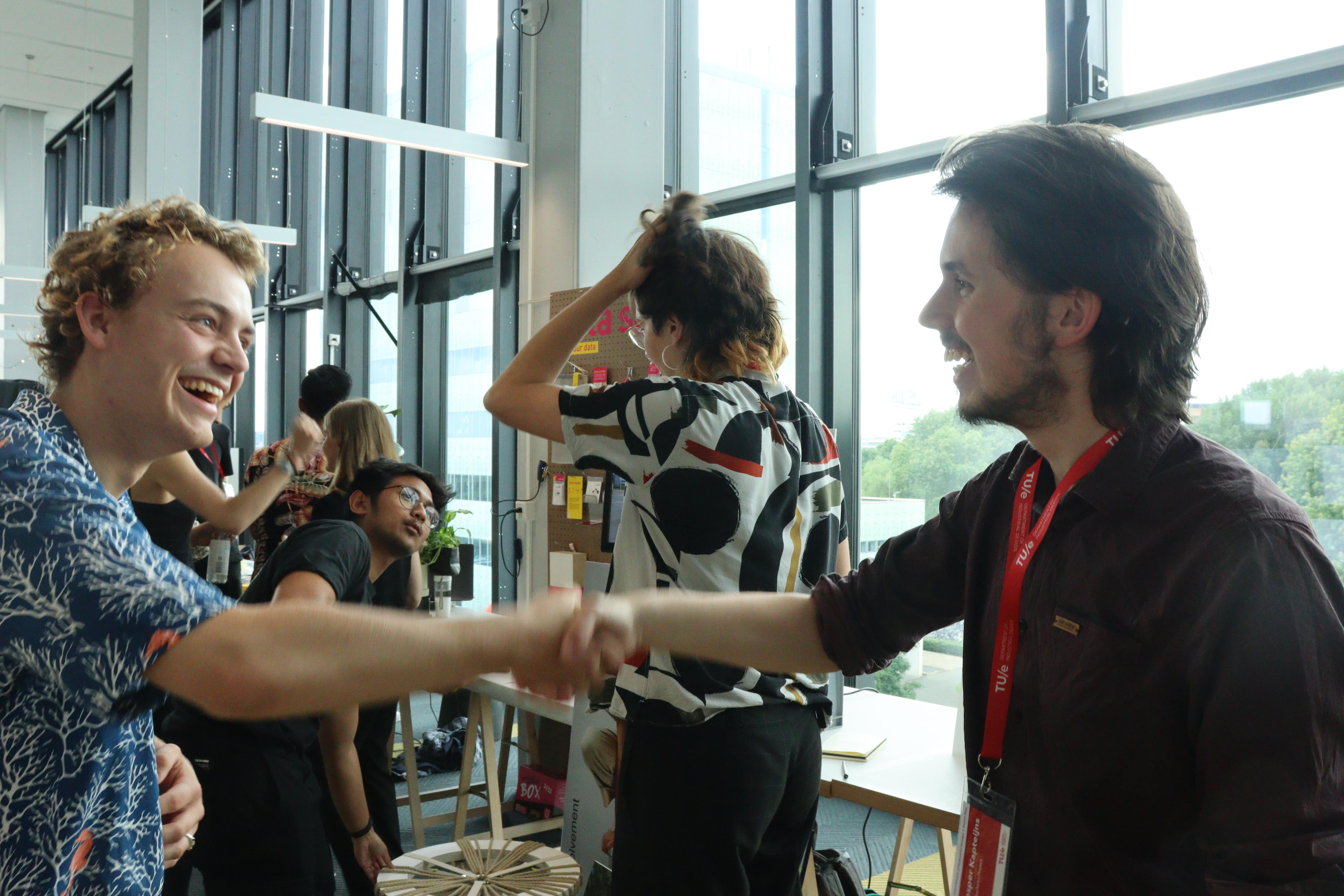
When just having started out with the Industrial Design program, I was almost entirely focused on technical aspects during design projects. Over the course of my studies, I gained affirmation that these are indeed the areas that I would like to emphasize as a designer. However, I feel that I have developed to become a designer that includes a wider variety of perspectives into design processes. By now, I spend more attention to including potential users in my projects and have developed a personal conceptual style.
In my design processes, I highly value the creation of experienceable prototypes. I believe that these can be incredibly helpful to demonstrate how a concept could be realized and to gather more valuable feedback during user testing to validate a concept and find points for possible improvement. Therefore, I put a lot of effort into creating a context that matches a real-life context as closely as possible, both technologically and environmentally.
As a designer, I would describe myself as persistent, as well as flexible at the same time. I am not afraid to dive deep into a subject or spend a lot of attention to creating prototypes or setting up a user test. At the same time, I go about these aspects of a project with a flexible mindset and I know how to prioritize or find workarounds when hurdles arise that need to be overcome.
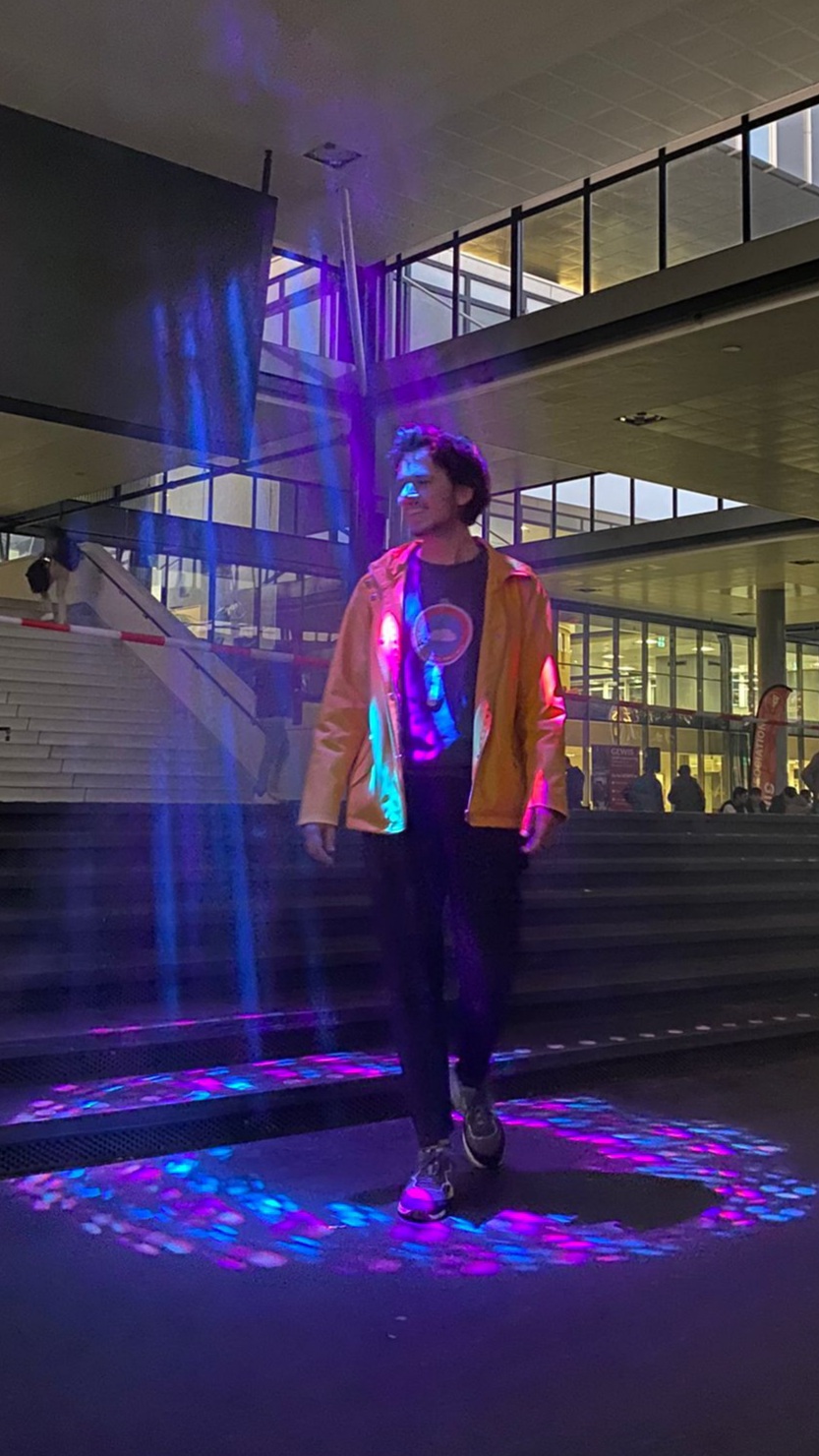
I believe that design can be used to create subtle, unobtrusive interactions. This way, it can support users in a seamless way, without consuming all of their attention. By making smart use of how human (visual) perception works, products or systems can be designed that facilitate intuitive communication, either between them and a user or amongst multiple users. In a world that is inhabited by an increasing amount of technological artefacts of increasing intelligence, thoughtful design can help users to make intuitive sense of automated decision-making and declutter their minds from an abundance of attention-draining stimuli.
In this regard, I see a world of opportunities for visual and multimodal interactions. Nowadays, an overwhelming amount of predominantly screen-based information and notifications craves the attention of users. By moving non-urgent information to the periphery of someone’s attention, mental load can be decreased without missing any important information. Additionally, it can make visible that which is invisible. As modern devices perform an innumerable amount of calculations to make decisions, it is important to clearly communicate these decisions to users so they can keep up and avoid confusion.
During design project 1, I designed Familight. Familight consists of two connected objects with integrated lighting, a teddy bear and a picture frame, that aim to strengthen the bond between grandparents and their grandchildren while they are away from each other.
This project was my first opportunity to explore my interest in working with light. Furthermore, it sparked my interest in working in a social context. These two aspects, light and social, form the foundation of much of my later design work.
.jpeg)

During my B3.1 semester, I worked as an intern at Studio Philip Ross, the lighting design studio from ID alumnus Philip Ross.
During this period, I worked on the realization of two lighting installations for the GLOW light festival in multidisciplinary teams.
For the 'Eye of Atlas' installation, I gathered all necessary information to map thousands of luminaires in and around the Atlas building so they could be animated.
For the 'Sketch your light' project, I guided a group of five students from different backgrounds towards the creation of five interactive platforms with which visitors could paint their surroundings with their gestures.
This experience has been greatly beneficial to my development as a designer by exposing me to working with modern lighting technology, working with people from multiple backgrounds and working in the creative industries.


For the past year, I have been able to further grow in design processes such as those that I encountered at Studio Philip Ross as the team lead of Team IGNITE, a student team that is focused on the design and realization of interactive lighting installations.
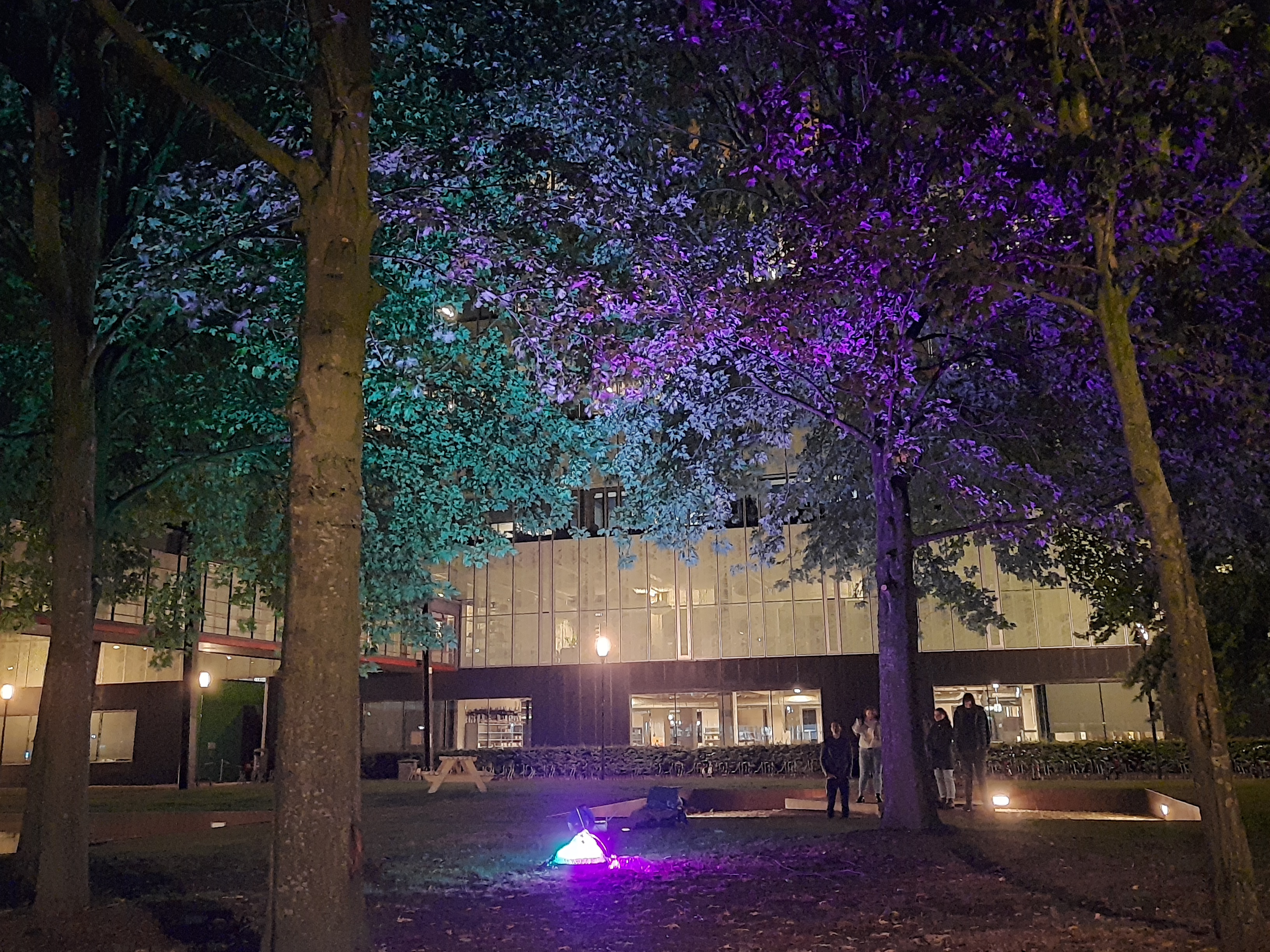
In this position, I have been leading the development of Unplugged, a lightbulb-inspired sculpture for the past edition of GLOW. The three-meter high installation featured the city logo of Eindhoven inside the bulb, which could be activated by interacting with the giant power plug attached to the installation.
Working in a student team has offered me the opportunity to go through a whole design cycle from the very first brainstorms all the way to realizing the final concept and showing it to a large audience.


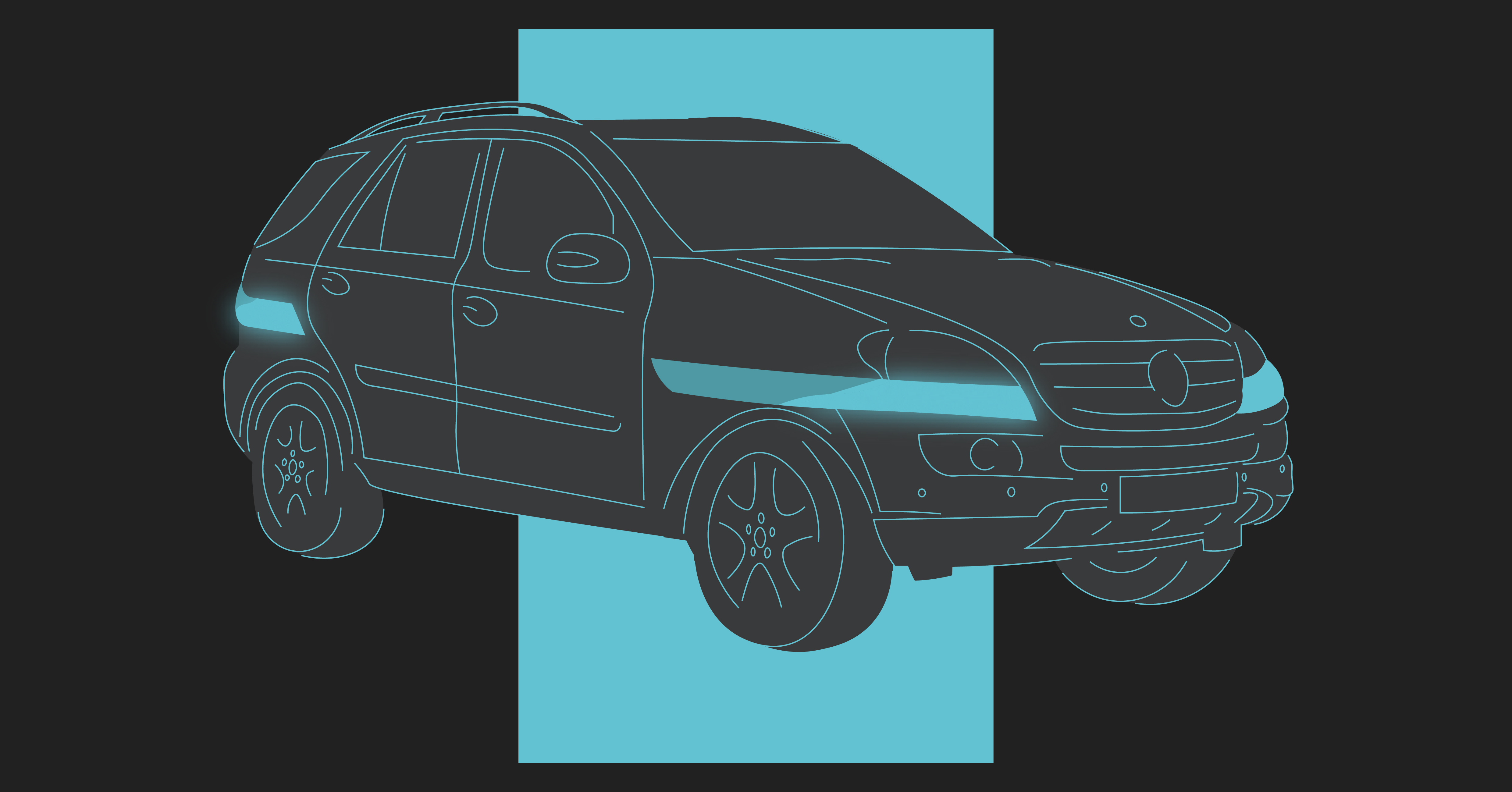
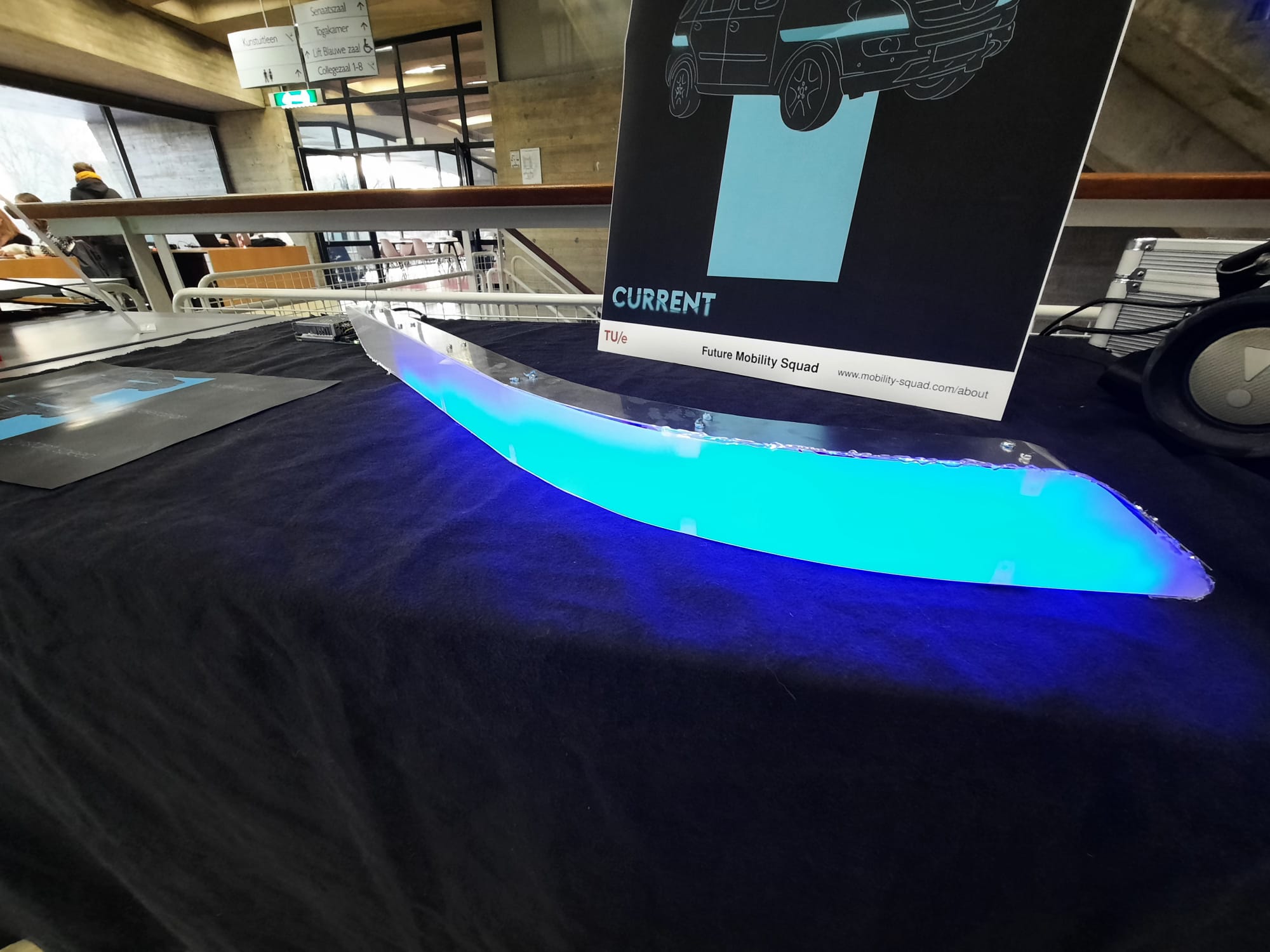
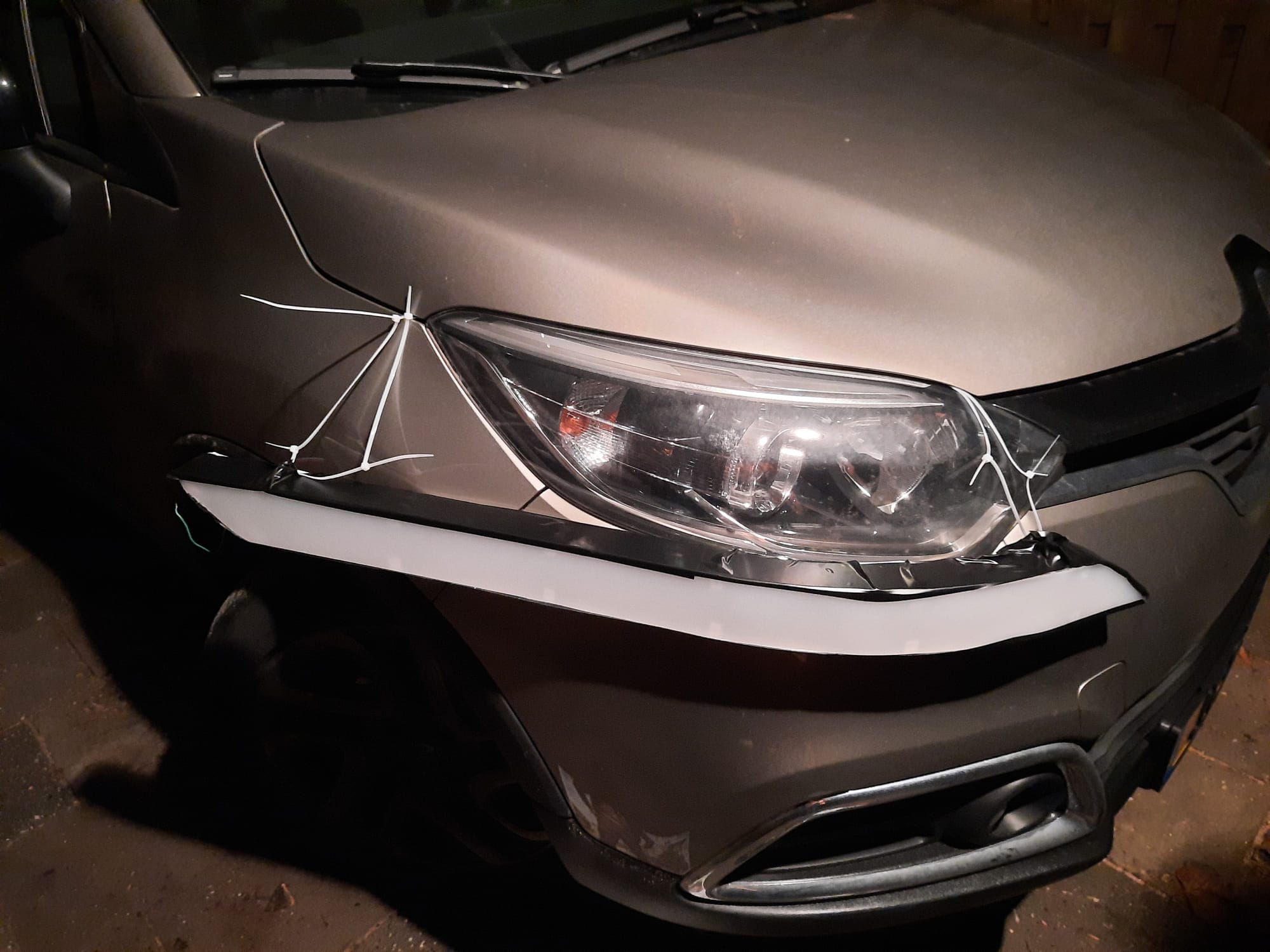
For my Final Bachelor Project, I have designed a new interface for vehicle exteriors that uses fluid motion as a metaphor to implicitly communicate kinetic motion patterns to vulnerable road users.
Please visit the link below for more information about the project on the Demoday platform.
The following section will briefly describe my overall growth within the expertise areas and how these were applied during my FBP.


In design processes, I have become familiar with creating visualizations and prototypes with various media, from sketches to renders to physical models. With an exploratory mindset, I use these techniques to investigate possible static and dynamic qualities of concepts. In this regard, I could improve by increasing the quantity of explorations, in order to explore a wider range of form factors and dynamic behaviours.
I would describe my personal style that I have developed as a designer as being founded on subtle design and calm technology. With my designs, I aim to support potential users by facilitating seamless and intuitive interactions between humans or between humans and a product, while at the same time not consuming all of their attention. The aesthetic that was developed for my FBP is a clear example of how design can improve interaction between people and technology in a subtle way.
Prototyping with interactive electronics plays an important role in all of my design projects. I strongly value the creation of functional prototypes, as I believe they can show the intended behaviour of a concept as closely as possible to potential users. To create these prototypes, I have a broad general knowledge at my disposal regarding circuits, sensors, actuators and microcontrollers (Arduino,ESP32, Particle Photon), as obtained through several courses (Creative Electronics, Making Sense of Sensors) and personal experience.
I can work with common digital prototyping tools (3D-printing, lasercutting), but I also know my way around a wide variety of manual tools for performing operations on wood, metals and plastics. Next to better conveying the intended look and feel of a project, being able to create high-fidelity prototypes makes it easier to create near-real-life experiences during a user test.
Throughout my Bachelor program, I have specialized in modern lighting technology. The USE line and technical trajectory on light has made me knowledgeable on the physics that are related to light and my internship made me more familiar with communication protocols and interactive lighting. During my FBP, I have been able to make use of this knowledge in the creation of an interactive prototype with a large number of LEDs.


Through several courses, I have gotten to know common user-centred design methods and have been made more aware of both positive and negative impacts that technology can have on society (User-Centred Design, USE line). More specifically, through the USE line on light, I have become knowledgeable on the impact that light can have on a psychological and social level. As a designer, I am interested in how visual perception of humans works and how this can be used to improve designs, for example by increasing visibility or interpretability (Project 1 design, Project 3 design research, FBP).
I value making user testing during my design projects as experienceable as possible. Especially during my FBP, I have been able to perform user testing in a setting that approaches a real-life context, with both quantitative and qualitative methods obtained from courses (Data Analytics for Engineers, Making Sense of Sensors, User-Centred Design) and literature. A possible improvement for me in this regard is to involve target users more frequently throughout a design process.
I have grown used to creating software during all stages of a design process. It has become habitual for me to create digital visualizations (Processing, Dialux) to explore the dynamic behaviour of a concept, as an interactive addition to traditional sketches and models.
Afterwards, these behaviours can be translated to microcontrollers (Arduino, ESP32, Particle Photon) to be able to create physical, experienceable prototypes. I can use data gathered by sensors to calibrate prototypes and make them function live, as well as for analysis afterwards so possible improvements to a concept can be identified, as I have done during my FBP.
Additionally, I am able to create prototypes of interactive systems. I can conceptualize streams of data exchanges between multiple products which result in emerging phenomena, and create functional prototypes of these exchanges with several tools (OOCSI, Particle Photon).


The Design Innovation Methods course has made me familiar with several business tools that can be used throughout a design process (Business Model Canvas, PESTEL analysis, User Experience Journey Map). Before the start of a design process, these tools can be used to analyze what is already out there and what sort of context you are designing for. During a design process, they can be used to identify points for improvement and afterwards to form a business model around a concept.
During my internship at Studio Philip Ross, I could see in practice what it takes to run a one-man business in the creative industries. It made me aware of the formalities that need to be dealt with, but also different possible strategies that you can take to attract assignments and run them for example. As the team lead of Team IGNITE, I have been able to experience some of these business aspects in practice myself as well. I was involved in drafting the budget for a GLOW installation and also in attracting funds to realize it and gained experience with dealing with Chamber of Commerce regulations.
Although my experiences in this expertise area have been beneficial for my general development as a designer, I must admit that it is the area that relates the least to my professional identity as a designer. In a future career, I could see myself applying business skills to support my design activities in the background, but I would not see myself emphasizing this expertise area in my main design activities.
I have learned that every design (research) project has a different approach that works best for it. Therefore, after having tried out multiple design processes, I now typically use variations of the Reflective Transformative Design Process as a foundation for my design projects, as it can in nature be adapted to the needs of specific projects. While planning, I create general iterations and use moments of reflection in between those to concreticize what the most beneficial next step for the project would be.


Through the experiences that I have had working in multidisciplinary groups, I have grown as a designer who can keep the overview of the whole project. When working with experts from other fields, I try to ask them as many questions as possible to understand the topic better and to make communication easier.
As for communication, there are some aspects in which I could still improve. For instance, I left some room for ambiguity while explaining design concepts during FBP coach meetings, which made it confusing to discuss these. Adding more clarity to my communication style could help to prevent this.
Right after my Bachelor program, I want to continue in the Industrial Design Master program at the TU/e. As a complement to the Bachelor, I think the Master will help me to become more comfortable with functioning as an independent designer and also gives me the opportunity to dive deeper into the 'Technology and Realization' and 'Math, Data and Computing' Expertise Areas, which are the areas in which I would like to specialize as a designer.
During this period, I also want to further explore my future career path. If possible, I would like to do an internship during my Master at a larger design studio or start my own studio, so I can gain more experience in a safe environment on what it is like to work in the creative industries and if that is indeed a path that suits me.